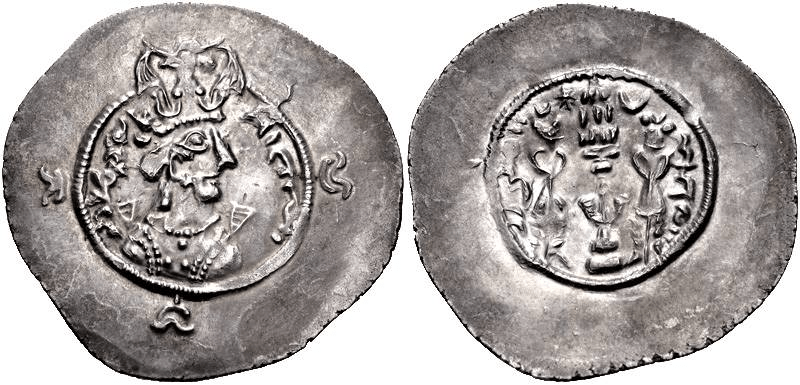
Iran

‘The Romans Customarily Ask First’

A note on the rhetoric of peace negotiations, with reference to the 562 Sasanian-Byzantine peace negotiations

In a world that continues to fight, usually without much reason, and keeps on invoking the past to justify present hostilities, looking at the wars of the past, and more so, the peace that follows them, can be of much use. With every conflict, we are constantly told that things are “different,” dispite the fact that the reason those conflicts start of commonly because of how “similar” new disagreements are to those who were before them. While fighting on the actual battlefield can be a very confusing and complicated process to follow – although that has its own fans and scholars – understanding what follows a battle is much easier thanks to the negotiations that lead to a process of peace. These negotiations, despite the passage of time, reveal themselves to be as repetitive as the wars they follow, and they also make constant references to that past. While the present conflict that occupies our minds at present, the joint American-Israeli attack on Iran and Iran’s surprising response, and the ongoing ceasefire and negotiations has but superficially made references to the ancient past (seee this very unusual Tweet: https://x.com/IRIMFA_SPOX/status/2058291965305762045), one cannot help but see similarities in negotiations and the stances of the belligerent sides at the ongoing peace process. The following, a quick recap of a famous episode of war and peace between the Sasanian Empire of Iran and the Eastern Roman Empire, bears some interesting similarities that might be at least amusing to read in light of the present conflict and the contemporary world. I am not claiming any ‘sides’ in this, but as a historian, wish to bring attention to how remarkably consistent the acts of war and peace negotiations have remained, and how much they can tell us of human fallibility, shortsightedness, and cruelty.

I. The Peace of 562 and Its Context

The Persian-Roman peace treaty of 562 AD was the resolution, formal if not quite final, of a conflict between Rome and Persia that had been grinding along, with varying degrees of intensity, for the better part of six decades. Its immediate background is the series of wars that had started with the siege of Amida in 502 and that Geoffrey Greatrex traces in his monograph Rome and Persia at War, 502–532.  Procopius, our great source for this episode of the war in his Bellum Persicum, describes this stage in an effective way, forming the bulk of our knowledge of the events (for Procopius, now also see Greatrex;s new translatio and commentary Procopius of Caesarea: The Persian Wars. CUP 2022). That conflict had produced the infamous Eternal Peace of 532, a settlement burdened with an unfortunately optimistic name: it held for eight years before the war was started over a conflict involving the Arabs living on the borders of both empires in Syria and southern Iraq and the Lazican territory on the southeast of the Black Sea. By the late 550s, both powers had reasons to want a durable arrangement. Rome had overstretched itself across multiple theatres; Persia had its own frontier anxieties to the east and needed to secure the west. The result was a negotiated fifty-year peace, conducted at the frontier city of Daras and documented by Menander Protector in what survives as Fragments 6.1–3 of his History.

What makes the 562 negotiations remarkable, beyond their diplomatic outcome, is their texture. Ekaterina Nechaeva, in her study Embassies, Negotiations, Gifts: Systems of East Roman Diplomacy in Late Antiquity (Stuttgard: Franz Steiner 2014), has shown how late antique diplomacy operated as a structured system. Distinct phases, formal embassy, ceremonial reception, gift exchange, treaty ratification, followed by elaborate protocol, each carrying a weight of symbolic meaning that supplemented and sometimes substituted for, the substantive content of what was said. Menander Protector’s account of the Daras conference is one of the richest surviving illustrations of this system in operation: we have the opening speeches, the counter-arguments, the production of documents from inside diplomatic cloaks, the simultaneous signing of parallel treaty texts by envoys and interpreters, and the careful exchange of sealed copies. We also have, preserved almost accidentally, something Nechaeva identifies as characteristic of the genre, the gap between what the speeches say and what the speakers know perfectly well is actually happening. It is that gap, and its persistence across fifteen centuries, that makes Menander worth reading in 2026.

The negotiations in Daras, a Roman border town quite close to the Sasanian city of Nisibis (itself a bone of contention), took place between Peter, Master of Offices for the Roman Emperor Justinian, and Yesdegusnaph (MP. Yazdan-gushnasp), known as the Zikh, chamberlain and senior envoy of the Sasanian King of Kings Khosro I. At the start of the negotiations, both men spent a considerable amount of time explaining to each other that peace was desirable. This was one thing both sides could agree on, no matter which had been the initial belligerent. This is what justifies the verbose speeches leading up to the actual agreement, where each side is trying to establish its own moral refinement and justification, trying to outdo the other’s claim to being peace loving, despite having engaged in over half a century of almost constant warfare!

Peter, the Roman envoy, opens the Daras conference with a long speech. It is, by any measure, a remarkable performance. He tells the Persians that peace is good, that war is bad, that the human mind weighs advantages, that fortune is unstable, that all men share the same nature and the same emotions. Part of this is to put a sense of urgency in the talks, essentially highlighting the limited time and opportunity that there is for the negotiations. This is a diplomatic trick that is quite old, but also enduring, and can be observed even today in high stakes negotiations, where one side emophasises the urgency of negotiations and presents their own willingness and desire to reach an agreement as a a brief “opportunity” offered to prevent a restoration of the state of war. Crucially though, Peter is insisting that Rome is not proposing peace because it fears Persia, but because it is so very fond of peace that it wishes to get there first! This is somehow a strange admission perhaps showing the real Roman conditions, as the Roman sources often suggest that the Persians were initiators of peace – and thus the weaker partner in the negotiations (see Nechaeva 2014: 85-86). Here, Peter says (all quotations are from Menander Protector, Fragment 6.1-3; trans. R. Blockley, 1985):

The statement, while claiming a moral stance, seems to rather suggest a desire to pre-empt any further Sasanian action, and perhaps an opportunity to dictate terms, that might then either reveal or cause Roman weakness. It could also reveal a Roman anxiety at mounting Sasanian advantage in the war, and thus need for an immediate end to the hostitlities.

The Zikh listens to all of this with evident patience, and then replies in a manner that deserves to be quoted in full, since it is one of the more elegant diplomatic put-downs in the historical record:

The Zikh, an eidently straight shooter to borrow from American slang, seems not to be fooled by the rthetoric. Not holding anything back, the Zikh continues on, describing what he feels is Peter’s rhetorical strategy in using peace as a way of hiding the Roman disadvantages, posing as morally superior in the conflict and meaning to avoid war:

Here, the Zikh clearly presents the Sasanian side as the victors, a claim which does NOT get disputed by Peter later. He also appears to suggest that the Romans should present terms first, which would suggest that he wants to have the advantage of knowing what the Romans really want before agreeing to any actual negotiation. The Zikh then goes on to claim equal Persian love for peace and acceptance of the Roman request for a cease fire and end to hostilities, with the condition that “a treaty without a time limit and a fixed amount of gold every year from the Romans.” The final treaty terms are summarised by Menander as:

A fascinating further detail is what Menander tells us of the process of keeping the terms of peace in tact, providing each side with copies written with much care:

A final fascinating detail is Menander’s careful description of the language used for the treaty documents. In addition to guaranteeing terms of “equivalent force”, the treaty documents were drawn in both languages, as Menander says:

So, each side not only got sealed treaties, but were given a translation of the way the other side’s documents were written in order to guarantee consistency and assure that terms were not added or ommitted on either side’s treaty.

Peter’s speech at Daras is, in essence, a piece of diplomatic throat-clearing: it establishes the speaker’s logical stance, preëmpts the obvious counterargument, and frames the request for negotiation as a gesture of strength rather than necessity. The Zikh seems to see straight through it, not because he is particularly shrewd, though Menander notes he was “an extremely intelligent man”, but because this is simply what diplomatic speeches do, and both parties know it. These principles and rhetorics seem understandable and agreeable to most of us today, even their nuances being easy to comprehend, because they have stayed largely the same into our times. Peace negotiations and conflict resolutions still operate based on the same rhetorical and moral muscle-flexing and claims.

II. On Financial Arrangements and the Saving of (the water) of the Face

In the seventh century, as with today, wars had a strong economic aspect to them. Apart from the economic motivations, wars – and the subsequent peace always included payments of money, seen as guarantees against breaking of peace as well as reparations. The treaty of 562 involved a payment of thirty thousand gold nomismata per year from Rome to Persia. The provision for this payment, as described by Menander Protector, was highly favourable to the Sasanians:

The financial architecture was constructed specifically to avoid the word tribute, despite the fact that both sides knew what it was. The fictions associated with this payment previously, namely that it was for the mutual protection of both empires against the attacks of the steppe people (as mentioned in previous treaties such as 540) is notably missing here. This might be due to the fact that as the Zikh claims, the Sasanians had by that point managed to rid themselves of the Hephthalite threat to the east:

Fragment 6.3 ends with a sentence of quiet devastation. Peter travelled to the court of Khosro to discuss the one outstanding issue, the territory of Suania, in the Caucasus, directly with the King of Kings. Here, he gave his arguments. The King gave his. Several further rounds of increasingly technical disputation followed, involving lists of historical rulers, claims about the customs of the Lazi, and a document produced, somewhat theatrically, from inside Peter’s cloak. None of it worked. “Peter made no progress over Suania and left the land of the Medes without settling the matter. Nevertheless, he had made a treaty with the Persians.” The never resolved issue, like so many in our times, remained unresolved. The state of war continued, as we know, for another half a century, before the start of what has been called the Last Great War of Antiquity, or if you excuse my semi-humourous take on it, the First Great War of the Middle Ages.

Conclusion

Wars are as much about peace as they are about actual fighting. We are used to see wars as battles between soldiers, of bloodshed and destruction in the battlefields, and increasingly sadly in civilian areas. But soldiers are seldom those who hold any grudge against each other and are almost never the ones who start wars. Wars are, in fact, most often between GreatMen (yes, Men, as Ursula K. le Guinn reminds us), and as such, those Great Men often also need to end wars with negotiations and peace, where the war often continues for longer than it was fought on the battlefield. Focusing on negotiations, and tactics of negotiations, is a good way of understanding the motivations, tactics, and Grand Strategies of powers who commission them, and maybe a way of understsanding the futility of war.

A few things to read…

Blockley, R. C., introductory essay, in The History of Menander the Guardsman, F. Cairns, Liverpool, 1985. (Annotated edition of fragments used: Rezakhani, Khodadad. Menander Protector, Fragments 6.1–3. Sasanika Sources, 2008. Available at https://cpb-us-e2.wpmucdn.com/sites.uci.edu/dist/c/347/files/2020/01/Menander6-1.pdf)

Greatrex, Geoffrey. Rome and Persia at War. Leeds: Francis Cairns, 1998.

_________. Procopius of Caesarea: The Persian Wars.Cambridge University Press, 2022

Greatrex, Geoffrey and Sam N. C. Lieu. The Roman Eastern Frontier and the Persian Wars, Part II AD 363–630. London and New York: Routledge, 2002.

Nechaeva, Ekaterina. Embassies, Negotiations, Gifts: Systems of East Roman Diplomacy in Late Antiquity. Geographica Historica, Bd 30. Stuttgart: Franz Steiner Verlag, 2014.

Peroz and Narseh: Coins of Post-Sasanian Princes in Balkh

It is well-known that after the death of Yazdgerd III, the last Sasanian Shahanshah (king of kings) in 651, an attempt was made by his sons Peroz and Wahram to recover at least a part of his empire with the help of the Chinese.[1] These attempts, however, were not successful and finally resulted in the withdrawal of the remnants of the Sasanians royal family to the Tang’s newly built capital of Chang’an 長安, where Peroz died in 678/679. He was buried in the mausoleum of Gaozong of the Tang and an inscription naming him king of Persia 波斯王 and Commander of Persia 波斯都督 was included on a nearby pedestal. Before his death, Peroz had managed to secure the permission to build a temple for the exiled Persian community in China, although we aren’t quite sure of this was a Zoroastrian, Manichaean, or Christian temple.

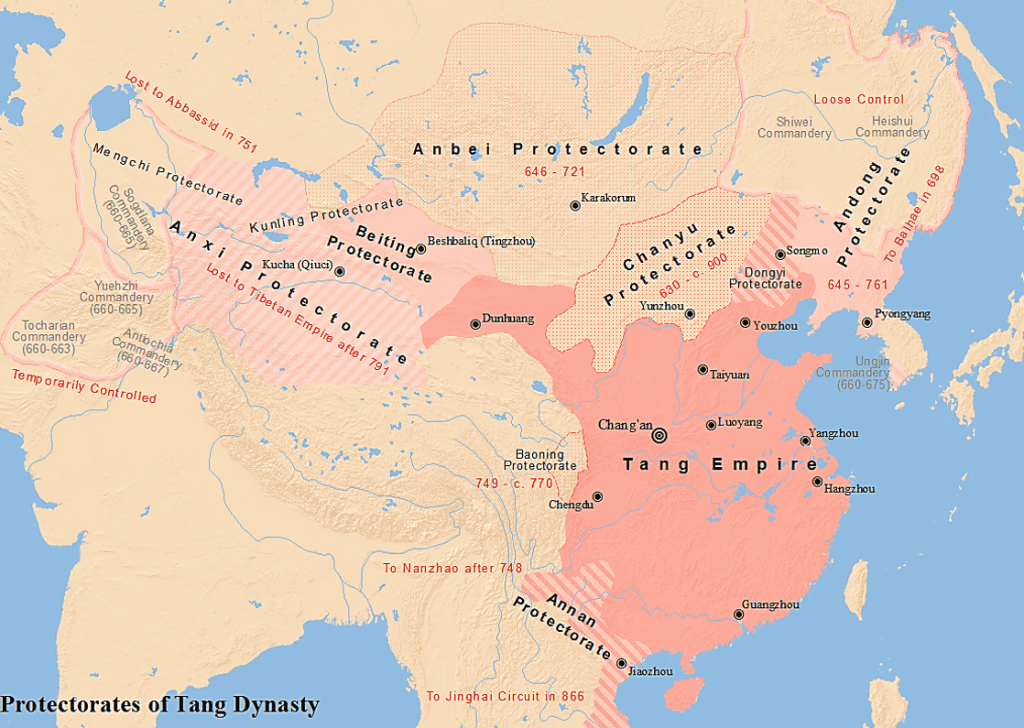
Map of the Tang Empire at the height of its power in the early 8th century
Statues at the tomb of the Gaozong emperor of the Tang

Before meeting his end, Peroz had put up a fight against the invading forces of the nascent Islamic caliphate and keep at least an illusion of ruling his father’s territories. Specifically, following Yazdgerd’s death in 651 in Marw (Merv), Peroz had set up a minor kingdom in a city that the Chinese call Jiling 疾陵, which is usually thought to be the city of Zrang/Zaranj in Sistan.[2] Considering that Sistan was not really invaded until the caliphate of Mu’awiyya (661-663), we can imagine that it was the conquest of Sistan that drove Peroz out of Sistan and to Tukharistan around 663. This would also support Daryaee’s suggestion that all of those Yazdgerd year 20 coin issues were in fact minted in Sistan, presumably in the 10 years of so when he ruled after his father there.[3]

The Conquests of early Islam

On the other hand, Peroz’s appearance in Chang’an happens between 673 and 674[4], meaning that he had spent the previous decade or more in the west. Based on Chinese sources (which might very well be exaggerations), he ruled in Tukharistan, under Chinese auspices, trying to recover his kingdom. Presumably, it is after his arrival in Chang’an that his son, Narseh 涅涅师, was raised to the throne in his stead by the Chinese general in Tukharistan. But Narseh too, after a 20 year struggle, could not recover any territories and returned to China in 708-709 and died in Chang’an. Now, apart from the year 20 issues of Yazdgerd III that we can assume were continually re-issued by Peroz, we have very little evidence of coins from either Peroz or Narseh, while we can only assume that some should have existed as coinage was firmly established in this region both as a sign of authority and for means of circulation. However, no certain coins can be attributed to either authorities, leaving us puzzled.

If we don’t consider the claims of Tang chroniclers as pure fabrication, we should then look at the selection of coins that we do have and consider that they might in fact contain some coins that can be attributed to either Peroz or Narseh, or both. Somehow, these coins have escaped the attention of the scholars somehow, mainly in any clear indication of the name of either authority. The issue is that the inscriptions on the coins of East Iran are written in a maddening variety of scripts, ranging from cursive Bactrian to Pahlavi, Brahmi, and Arabic. A few coins have clearly legible inscriptions, and given the frustrating ambiguities of both the Pahlavi and the Bactrian scripts, all sorts of readings can be proposed. To make things even more complicated, the coins in the region were often issued based on established prototypes, thus coins of the previous authorities – many of them originally based in Sasanian issues of the fourth and fifth centuries. So, it is not too much of a surprise if a coin does not immediately jump out or can be attributed to an authority otherwise known from the pages of standard historical narratives.[5]

The available array of coins from the Hindukush region in the post-Sasanian period is quite bewildering, with many local authorities issuing silver and copper/bronze coins. Many of these coins, for example those of the iltäbär, or Zhulad Gozgan belong to authorities whom we know from historical sources. Others, such as Tegin Khurasan Shah and his son Phrom Kesar, are mainly known from their coins but are entering the gaze of history through discovery of newer sources such as inscriptions.[6] Others such as “Spur Martan Shah,” or “Sero” or “the Bactrian Yabghu” are completely unknown and still waiting identification. So, I would like to venture into a group of these, namely the last named Yabghu, to find some coins that might be connected to Peroz and his son Narseh, the last claimants to the Sasanian throne in the East.

Silver drachm of Zhu(n)lad Gozgan, “Garigo Shaho”

The Yabghu of Balkh/Bactrians

The ultimate source, in English, for the coins that I like to consider here is the monumental two volumes produced by the Austrian numismatist, Klaus Vondrovec, who I can also call a friend and a mentor.[7] In these volumes, Klaus has done a magnificent job of studying the coins from east Iran from the end of the Kushano-Sasanian period to the complete control of the area by the Muslims in the eighth century. His meticulousness has rendered a wonderful resource, detailing typologies, iconographies, and inscriptions of each coin, and providing his own innovative groupings and analysis, mainly based on the previous work by Robert Göbl, but furthering the study of these coins manifold.

Section 9 of Klaus’ work is devoted to the coins produced under the suzerainty of the Western Turk (Gök Türk) Empire, originally founded on the second half of the sixth century and continuing until the late 7th/early 8th century when it was destroyed and temporarily merged into the Tang Empire of China. It was in fact the Chinese advances westwards to destroy the Western Turk that brought them into contact with the Islamic caliphate, resulting in the cataclysmic Battle of Talas that checked both the western ambitions of the Chinese and the eastern expansion of the Caliphate.[8]

The late Sasanian and the Western Turk empires

The early coins of this period are the continuation of what Klaus, following a suggestion by Göbl, has called the “Alkhan-Nezak Crossover” series. These are the coins of the period before the Western Turk take over of the Hindu-Kush region and show elements of both the Nezak Shah group (rulers of Kabulistan and Zabulistan), as well as those of the Alkhan group (a group of “Iranian Huns” who had gone over to conquer northern India in the fifth and sixth centuries).[9] By Klaus’ estimation, a part of the Alkhans had returned to the region of Kabul and Zabul and somehow integrated into the Nezak Shahs, and merging their distinctive coinage style with that of the Nezak Shahs, establishing their own Alkhan-Nezak Crossover group.

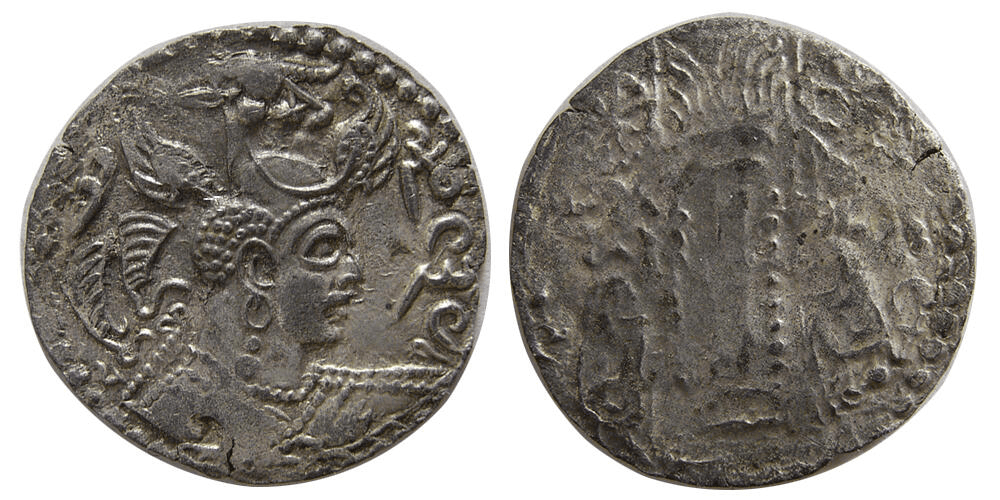
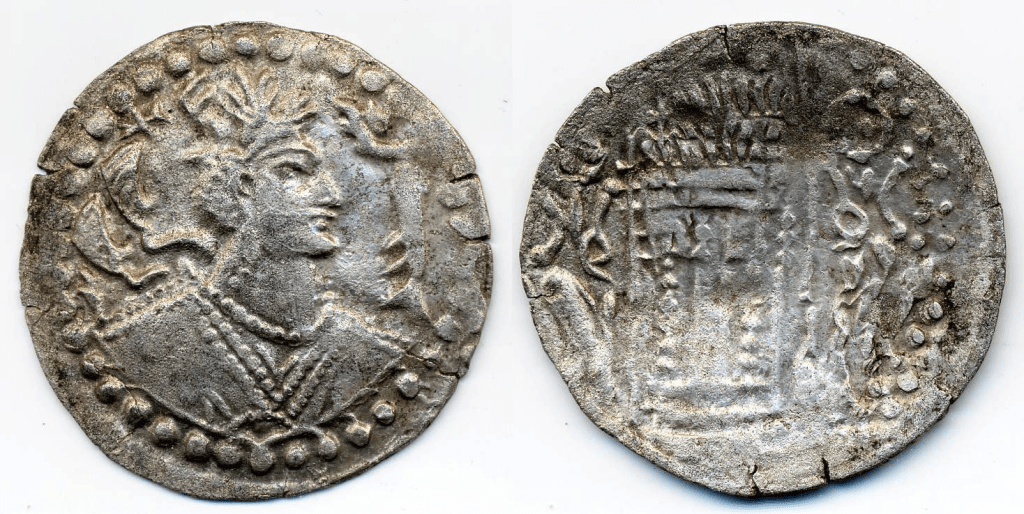
Silber drahm of an Alkhan king
A coin of Nezak Shah
An Alkhan-Nezak Crossover coin

The first authority that Klaus Vondrovec assigns to the Western Turk period is an authority on whose coins inscriptions in Bactria and Brahmi render his name as Sri Shahi (a mix of Indian and Iranian titles: “the Perfect/respected King”). This is respectively written as σριο þαυιο (with spurious Bactrian final -o) in Bactrian and as śrī ṣāhi in Brahmi on two different sets of coins which share the same iconography and typology. On the Nezak and Alkhan-Nezak Cross over coins, the name of the authority, Nezak Shah, was written in the Pahlavi script as nycky’ MLK’.[10] But in these coins, the Sri Shahi inscription has replaced the Pahlavi legend. The dual languages, one showing influences from the northern slopes of the Hindukush, historical Bactria and Tukharistan, and the other from the southern side, Kabul and Gandhara, is interesting and might suggest that Sri Shahi, whoever that he was, had influence over a wide range of area on both sides of the Hindukush, possibly making him a sub-king of the Western Turk, or an independent ruler – if the second half of the seventh century date that Vondrovec gives him is correct.

Coin of Sri Shahi

Another type of coin that Vondrovec mentions bears a Pahlavi legend on it that reads ybgw bhlk’n, so the Yabghu of Bactrians/Balkh.[11] This title would indicate the authority of the issuer in Balkh and Tukharistan, to the north of the Hindukush. However, Klaus reads a reverse legend on the coins as z’wlst(’n) and speculates that these coins might gave been issued in the area of Zabulistan, to the south of the Hindukush. There is an analogy that is suggested here in comparison with the coins of another authority called “Pangul” (who I have suggested is the same person as Amir Banji mentioned by Minhaj Seraj) who seems to call himself both a ruler in Balkh, while issuing coins with the mint signature of Rakhvad (al-Rukhaj) in the area of modern Lashkar Gah in Afghanistan. I am not sure if this can be entertained though, and have a really hard time reading the inscription there as z’wlst the way Vondrovec does. But aside from the mint, the iconography of two of the coin types is interesting and worth looking into.

Specifically, these are Klaus’ types 265 and 266, both showing a beardless man (Vondrovec p. 528). Klaus suggests that these might be a reference to the teenage Ardashir III who ruled the Sasanian empire for a bit more than a year in 628-629/630 and whose coins show a beardless man. But I don’t quite understand why Ardashir III coins should be reissued, with a whole new iconography added, after his death and much later, in the area of Balkh, where he never held any authority. The beardless bust showing an immature person though, that I understand and support!

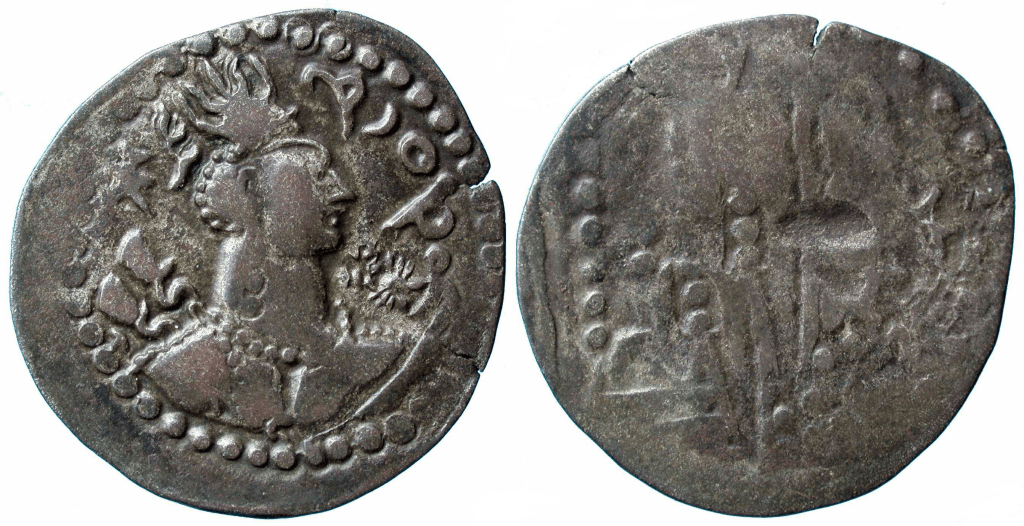
Yabghu of Balkh, type 265, possible authority Narseh (Pahl. nrsyh’)… the mint name reads hlbwc (corrupted for Rakhwad?) year 10?

So, who could this beardless man be? My suggestion here is that this is Narseh, the son of Peroz, who has been left in charge of the Tang Command of Persia after his father’s move to Chang’an. We have no idea of Peroz’ age. Presumably his father, Yazdgerd III, was a teenager himself when he was installed in the throne in 632. We might assume that Peroz was born after this, say 635 to have a round number, and when he died in 678/79, he was about 43-44, a respectable age to die in the 7th century, although quite early. Narseh could have been born quite early and be in his early to mid-twenties, or if we assume a later birth (say while his father was “securely” ruling in Sistan in the 650’s and early 660’s), he would be a teenager indeed. So, the young bust for him would be quite appropriate.

The two types that show the beardless man bear a very elaborate crown. This crown carries the wings on the crown of Yazdgerd III, the father of Peroz, but also has a buffalo’s head on top of an elongated “pedestal”. These buffalo heads were first introduced by the Nēzak Shahs and seem to be their invention, so their appearance on these coins say something about the “local” nature of these issues. While they are very Sasanian in style and bear a Pahlavi legend, they also add a local flavour (and thus authority and circulation) by adding a local piece of iconography. The single border reverse also means that these coins are pre-687 (the shared terminus post quem by which Vondrovec dates the relative date of the later coins) and belong to a period before the introduction of Arab-Sasanian coin types to this region. On some of these issues, I read the legends n(?)rsyh’ in Pahlavi, a name that could clearly point to the identity of the authority as Narseh, the son of Peroz.

A related type, 265A, using the same iconography but showing an older, bearded man, in silver and copper drachms. In addition to being bearded, the bust on the reverse is also wearing a crown with a crescent and a star in the front, something that had become associated with the outside margins on the coins of Khosrow II where they appear in four cardinal points. In front of the bust on some of the coins, a Pahlavi inscription can be read, an I provisionally and with much uncertainty propose the reading of kd(y) bwhl(‘)n for it, possibly to be read as Kay Wahram, although the spelling would be significantly different than the normal spelling of Wahram as wlhl’n, so I have great reservations about it. as One thing that unites all these coins, aside from the iconography, is the presence of “tamga S 61”, a sign consisting of a half circle with another sign, resembling an open V with wings. These tamgas appear in the same places that a crescent and a star would appear on the coins of Khosrow II, on the outside margins of the obverse, except one example of it occurring on the reverse as well of the type 265A, variant 3. Coins of type 265A also carry a mint year of 15, although it is not specified based on which calendar. The coins also mainly carry the mint name of LHW, localising them in Rakhwad/Al-Rukhaj, in Sistan. We can only assume that this is a reference to the regnal year of the authority it depicts. I would attribute this related type as either issued by Narseh himself when he was older, or possibly belonging to Peroz, or his brother Wahram?, issued before he had to leave for China.

Yabghu of Balkh, type 265A, possibly with Pahl. kd(y) bwhl(‘)n (Kay Wahram?) on the reverse, mint LHW(d)? (Rakhwad/al-Rukhkhaj?)

The question remains as why the names of the authorities cannot be found on the coin. In my opinion, there are two answers to be given here. One is that these Yabghus, bearing a title that we known from the Hephthalite period onwards, were actually governors of Peroz and Narseh, ruling over some of the dudufus 都督府 of the Tang Persian (Anxi) Protectorate 安西都護府, and thus issuing coins using their title and the position. Alternatively, these are Peroz and Narseh themselves, but that living under Tang suzerainty, they only mention their position as Yabghus of Balkh, on their coins. However, the extension of their power to the southern Hindukush, observed from the spread of the coinage circulation to Zabulistan – much like Sri Shahi – is an indication of their wider influence beyond Balkh, perhaps even expressing their claim to Sistan, from which Peroz had escaped to Balkh.

The administrative divisions of the Tang Empire in the west

[1] Quite a few studies of these, some with more care than others, have been published. The sources are still most easily available in Chavannes, Edouard. 1903. Documents Sur Le Toukiue (Turcs) Occidentaux. St. Petersburg: Commissionnaires de l’Académie Impériale des Sciences. Daffina’s short, but monumental work remains one of the best studies of the subject, Daffinà, Paolo. 1983. “La Persia Sassanide Secondo Le Fonti Cinesi.” Rivista Degli Studi Orientali 57: 121–70. A brief discussion of all these plus newer observations is Compareti, Matteo. 2003. “The Last Sasanians in China.” Eurasian Studies 2 (2): 197–213.

[2] Comparetti 2003, 206. However, see Hamidreza Pashazanous, Ehsan Afkande, “the Last Sasanians in Eastern Iran and China” Anabasis 5 (2014), 139-153 for an argument against this, rather putting Jiling in Tukharistan.

[3] Daryaee, Touraj. 2006. “Yazdgerd III’s Last Year: Coinage and the History of Sistan at the End of Late Antiquity.” Iranistik: Deutschsprachige Zeitschrift Fur Iranistische Studien 5 (1 & 2): 21–29.

[4] Comparetti 2003, 207

[5] For an example of this, see my article identifying certain coins from the area of western Tukharistan as belonging to characters said to be the ancestors of the Amirs of Ghur by the famous 13th century historian, Minhaj Siraj Jowzjani in his Tabaqat-e Nasseri: K. Rezakhani. 2020. “Pangul and Bunji, Zhulad and Fulad: a Note on the Genealogy of the Shanasbid Amirs of Ghur.” In Dinars and Dirhams: Festschrift in Honor of Michael L. Bates, edited by Touraj Daryaee, Judith A. Lerner, and Virginie Rey, 219–30. Irvine: Jordan Center for Persian Studies and Culture.

[6] For the newest example of this, see Nicholas Sims-Williams. 2020. “The Bactrian Inscription of Jaghori: A Preliminary Reading.” Bulletin of the Asia Institute 30.

[7] Klaus Vondrovec. 2014. Coinage of the Iranian Huns and Their Successors from Bactria to Gandhara (4th to 8th Century CE). Vienna: Verlag der Österreichischen Akademie der Wissenschaften.

[8] For a general review, see Denis Sinor. 1990. “The Establishment and Dissolution of the Türk Empire.” In The Cambridge History of Early Inner Asia, edited by Denis Sinor, I:285–316. Cambridge: Cambridge University Press.

[9] For these, see the excellent work produced by another brilliant Austrian scholar, Matthias Pfisterer, 2013. Hunnen in Indien. Vienna: Verlag der Österreichischen Akademie der Wissenschaften.

[10] The reading of this inscription, previously read as Napki Malka and long known as that, is one of the more exciting stories of ancient studies. See J. Harmatta. 1969. Late Bactrian Inscriptions, Acta Antiqua Academiae Scientiarum Hungaricae 17, 408, and Richard N. Frye, “Napki Malka and the Kushano-Sasanians,” in Near Eastern Numismatics, Iconography, Epigraphy and History: Studies in Honor of George C. Miles, ed. Dikran K. Kouymjian (Beirut, 1974), 115–22.

[11] There is some debate as how to read this, either as Bactrians or Balkh (see Vondrovec p. 527 and other places). I prefer to consider this “that of Balkh” (in analogy to Ērān) and don’t get too worried if this is a reference to the people or the land.

Barāyé: a Song of Protest and Compassion

You can now read this entry on Ajam Media Collective’s site: https://ajammc.com/2023/02/09/baraye-irans-song-of-protest/

Episode 11: The Kingdom of Anshan and Cyrus the Great

You can download Episode 11 from here… you can also check out the feed or try your favourite podcast index.

This episode will explain the local (mainly Anshanite) context for the rise of Cyrus, as well as telling a bit about the version of the story of the birth of Cyrus told by Herodotus.

1- Cyrus’ genealogy:

  • Cyrus’ name is written as Kurush (II) son of Kambujia (Cambyses I) son of Kurush (I) son of Chish-pish (Tespes).
  • He is said to be the son of Mandane (daughter of Astyages of Media) by Herodotus.

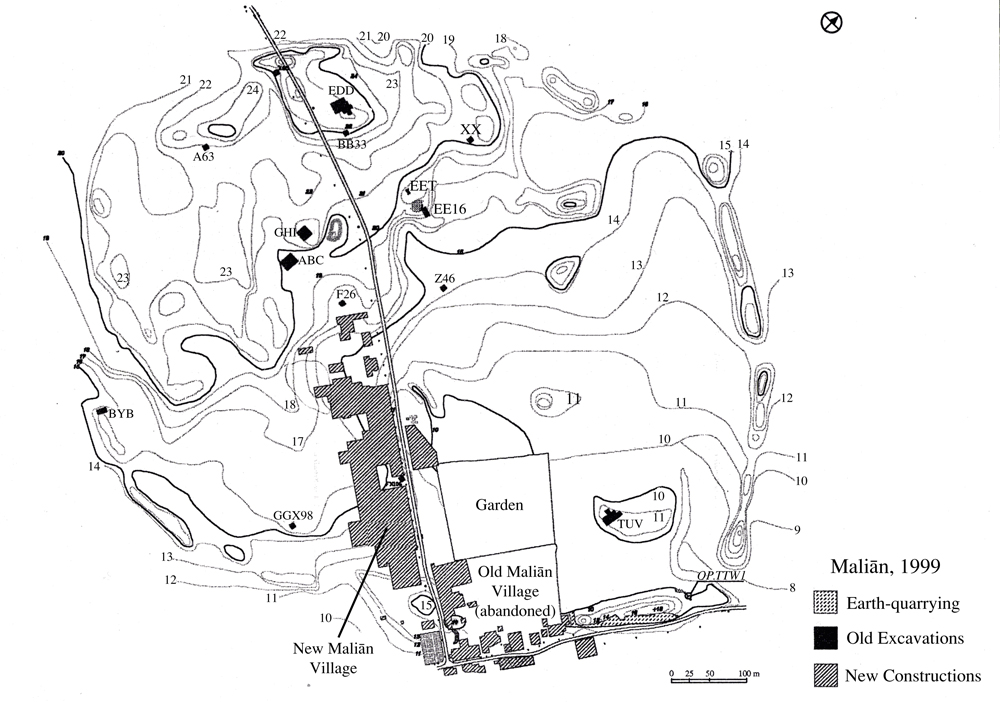
2- Here is a useful article on the site of Malyan/Malian (ancient Anshan) and the archaeological excavations of it.

3- Another article on the description of Cyrus as presented in Herodotus’ History.

Map showing the extent of the Achaemenid Empire, with the region of Persis showing in dark green,

Map showing the extent of the Achaemenid Empire, with the region of Persis showing in dark green,

Drawing of the archaeological site of Malyan (Anshan)

Drawing of the archaeological site of Malyan (Anshan)

Arial view of Malyan

Arial view of Malyan

This, often presented as

This, often presented as “portrait of Cyrus” is nothing but a fanciful drawing, based loosely on…

... this relief at Pasargadae. This is known as the Winged Guardian and is actually a composite image.

… this relief at Pasargadae. This is known as the Winged Guardian and is actually a composite image.

Episode 9, the Disappearing Kingdom: Medes and the Median Empire

You can download the new episode form this link

As usual, the feed is here.

Names of the characters mentioned

Dioces: the “founder” of the Median Empire according to Herodotus (possibly inspired by the Mannean Diakku, mentioned in Assyrian annales)

Phraortes: his son, possibly the chief Kashtariti mentioned in the chronicle of Essarhaddon

Cyaxares: the greatest of the Median kings, according to Herodotus, and the “conqueror” of Assyria. Possibly Umakishtar who is mentioned in the Gadd Chronicle and said by the Babylonian chronicles to be the person who sacked Assur/Ashur.

Astyages: the last of the Median Emperors, possibly Ishtumigu of the Babylonian chronicles.

median_empire_map chaldeamap

Modern, Artist's imagination of the "Hanging Gardens of Babylon"

Modern, Artist’s imagination of the “Hanging Gardens of Babylon”

Elamite names “galore”

One of the dear readers of this weblog, and listeners to the podcast, suggested that I make a list of the names I so much enjoy pronouncing. I think it is a good idea, except someone has already done it: http://en.wikipedia.org/wiki/List_of_rulers_of_Elam (for the chaps mentioned this week, scroll down to the Neo-Elamite period).

You should notice that pronunciation occasionally vary. Some of the Elamite pronunciations are being perfected. Temti-Human-Inshushinak now seems to be more like Tepti-Humban-Inshushinak (which is the way I say it). Some are better known (if you can say that about anything Elamite) by their Akkadian names. Shutruk-Nahunte is sometimes written Shutruk-nakhunte or Shutruk-Nahhunte. These are attempts at rendering Elamite in English. The sound /h/ in his name is a laryngeal sound which does not exist in English, similar to Arabic ح. 

Apart from these Elamites, I mentioned a few Assyrians and some Babylonians. Sargon II, Esarhaddon, Sennacherib, and Ashurbanipal are the Assyrian ones. Merodach-Baladan the Chaldean was really the only “Babylonian” I mentioned. 

I will post a similar list from the next episode on. 

Episode 8: the Neo-Elamite Kingdom

Well, here it is FINALLY! I got things to work, and meanwhile everything has changed (the feed is still the same)

This episode goes back to the Elamites and their adventures with the Neo-Assyrians, and their murky last century.

Here are a couple of more readings, one on the chronology of the Neo-Elamite period based on newer finds, and the second on Neo-Elamite “acculturation.”

A book on the Arjan Tomb, an important late Elamite discovery (you can read a condensed version with detailed interpretations here)

A map of Mesopotamia in the first century BCE

A map of Mesopotamia in the first century BCE

Seal of Humban-Kitin, son of Shutruk-Nahhunte II

Seal of Humban-Kitin, son of Shutruk-Nahhunte II

Eshkaft-e Salman in Izeh/Malamir

Eshkaft-e Salman in Izeh/Malamir

Hani, the "eastern" Elamite ruler, along with his wife and child, Eshkaft-e Salman, Izeh

Hani, the “eastern” Elamite ruler, along with his wife and child, Eshkaft-e Salman, Izeh

Neo-Elamite beaker, probably from Susa

Neo-Elamite beaker, probably from Susa

Assyrian victory relief of Ashirbanipal, showing Elamites being deported

Assyrian victory relief of Ashirbanipal, showing Elamites being deported

the bowl from the Arjan Tomb

the bowl from the Arjan Tomb


Episode 7: Indo-Europeans and Indo-Iranians

Here is the link to the episode, and the feed

This, sort of, is just the beginning. The Indo-European, the Aryan, and the Indo-Iranian languages and terms are such thorny issues, and I cannot even pretend to have answered them all. Hopefully this will set the stage for future discussions, and some questions, comments, and discussions here.

Notice that I tend to spell the word Ariia in order to name the “Indo-Iranians” as they are, and to distinguish it from the Aryan, which is used in a modern, political sense.

Check out the Bibliography for some book and article suggestions…

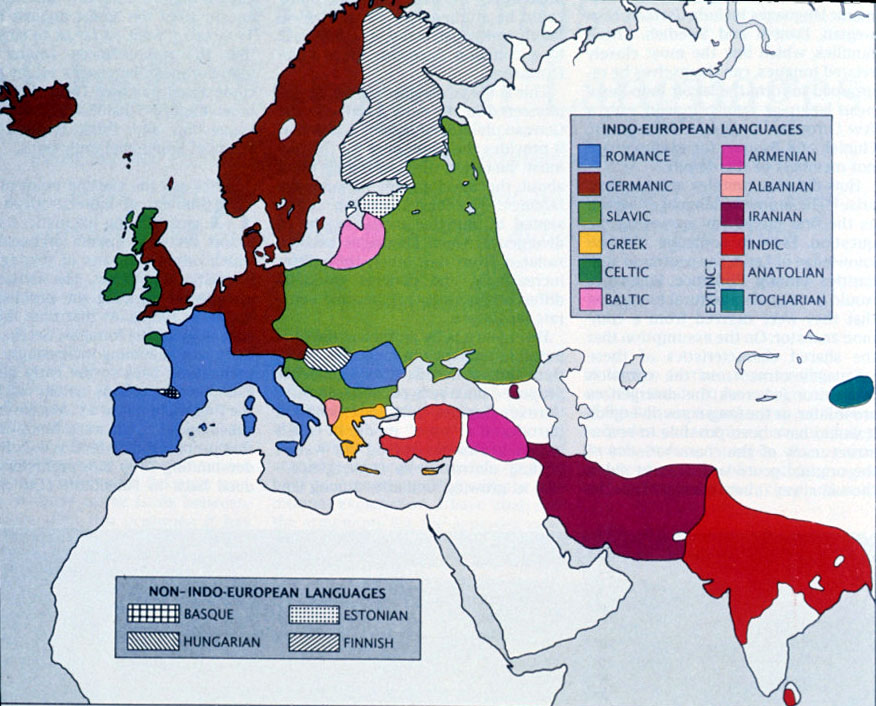
Schematic map of major Indo-European language groups

Schematic map of major Indo-European language groups

Map showing the extent of the Andronovo and BMAC cultures

Map showing the extent of the Andronovo and BMAC cultures

Episode 5: the Middle Elamite Kingdoms

The new episode is out. As usual, you can get it directly from here or subscribe to it from FeedBurner

I owe everyone an apology. I have moved for the year from Europe to North America, and the move proved more overwhelming that I imagined. I had to arrange too many things, teach, and do much writing. I have everything under control now, and will be sticking to a real schedule henceforth.

As for the episode, it is full of weird names, so here is something to orient you (and here is a useful list of all Elamite rulers, real and fictional!):

Names:

Kidinu: founder of the first dynasty (Middle Elamite I: Kidinuids)

Tepti-Ahar: the Kidinuid king who founded the site of Haft Tepe (Kabnak) near Susa, where his tomb also is.

Igi-halki: the founder of the second dynasty (Middle Elamite II: the Igihalkids)

Untash-Napirisha: the most important king of the Igihalkids, a maternal grandson of Kurigalzu I of Babylonia (of the Kassite dynasty).

Kidin-Hutran III: the Igilhakid who removed Assyrian puppets from the Babylonian throne.

Tukulti-Nimurta: the Assyrian king who removed the legitimate line of Kassite kings; they were later restored

Shutruk-Nahhunte: the founder and greatest ruler of the Middle Elamite III dynasty, the Shutrukids. He conquered Babylonia and put and end to the rule of the Kassites.

Kutir-Nahhunte: son and successor of Shutruk-Nahhunte

Shilhak-Inshushinak: brother and successor of Kutir-Nahhunte and the last great king of the Shutrukids

Sites:

Susa: Shusha; the low-land capital of Elam

Anshan/Anzan: the highland capital of Elam

Haft Tepe/Kabnak: site east of Susa; tomb of Tepti-Ahar

Al-Untash-Napirisaha: the archaeological site of Chogha Zanbil, with its impressive Ziggurat; the religious and political centre of the Igilhakids, near Deh-e Now, their home town.

Nebuchadnezzar I: the fourth king of the Babylonian dynasty of the Sealand and the bane of the Shutrukids

Hutelutush-Inshushinak: the last of the Shutrukids; he escaped Nebuchadnezzar and took refuge in Anshan/Anzan; also reliefs at Kul-e Farah in Izeh.

Middle Elamite relief from Kul-e Farah (Izeh)

Middle Elamite relief from Kul-e Farah (Izeh)

The Ziggurat of Chogha Zanbil

The Ziggurat of Chogha Zanbil

The aerial view of Chogha Zanbil/Al-Untash-Napirisha

The aerial view of Chogha Zanbil/Al-Untash-Napirisha

Episode 4: the Sukkalmah

This episode is about the Golden Age of the Old Elamite period, the period often associated with the title of Sukkalmah. Lasting between about 1950-1600 BCE, this is the height of Old Elamite power, when the Elamite king is known as the elder statesman of Mesopotamia and even Shamshi Adad and Hammurabi call Siwe-palar-huppak, “father”. The episode talks about the issues of ethnic make up of Elam, the highland vs. lowland duality, and prepares the scene for the Middle Elamite period, that of the Kings of Anshan and Susa (or Susa and Anshan, if you are reading the Babylonian texts!).

You can download the episode from here. You can also subscribe, using your favourite subscription tool!

Apologies for the long delay in releasing this episode. A series of life-crises prevented me from doing it any earlier. The episodes will be released on a weekly basis for the foreseeable future, at least until I catch up with the original schedule. Check in often, and please tell me what you think.

Old Elamite Statue

An Old Elamite statue with Linear Elamite writing

the Old Elamite relief at Kurangan

the Old Elamite relief at Kurangan

Map of the major sites in Elam and Sumer

Map of the major sites in Elam and Sumer

Some Bibliography:

The Archaeology of Early Egypt: Social Transformations in North-East Africa, c.10,000 to 2,650 BC (Cambridge World Archaeology)

Ancestor of the West : Writing, Reasoning, and Religion in Mesopotamia, Elam, and Greece

The Oxford Handbook of Ancient Iran (Oxford Handbooks)