History

Did Sasanians Remember the Achaemenids… or Should They Have?


(Any unauthorised quotations, copying, or use of the following is strictly prohibited)

The scholarly debate on whether the Sasanians, particularly the early Sasanians like Ardashir I, had any memory of the Achaemenids is as old as the modern study of Sasanian history itself. The grandfather of Sasanian history, Theodor Nöldeke opined that the Sasanians had not preserved any memory of Alexander themselves and all of their memory was borrowed from the Greeks and Romans. He invoked the evidence that the title Hrōmāīg “The Roman,” commonly used for Alexander in Pahlavi texts, is evidence that the Sasanians knew Alexander through the historiography of their rivals to the west.

The debate has raged ever since and has been the concern of almost all scholars who have studied the Sasanians or the early Islamic preservation of their memory in sources such as al-Tabari and even the great Shahnama of Ferdowsi. In a sense, the debate goes far beyond whether the Sasanians (even if we can think of them as a single unit) had any memories of the Achaemenids. The real question is: where are the Achaemenids in Iranian historiography? Where is Cyrus? Where is Darius? Where is Xerxes? Why are there no remains of these grand ancestors in medieval Islamic or Iranian historiography (with rare exceptions, of course, see below for al-Biruni)?

Scholars such as Ehsan Yarshater, A. Shapur Shahbazi, Josef Wiesehöfer, Touraj Daryaee, Rahim Shayegan, Matthew Canepa, Gregor Schoeler, and many others have written about this question in the past 100 years. Their opinions sometimes differ widely (from “there was no Achaemenid memory in the Sasanian period” of Yarshater to “Sasanians used visual culture techniques to harken back to Achaemenid authority” of Canepa) and sometimes are compromising (“mediated memory” of Shayegan or “memory replacement” of Daryaee). Almost all of these, perhaps except Yarshater at some places, accept the basic question that the Sasanians should have kept some memory of the Achaemenids. This assumption is largely based on the fact that, after all, the Sasanians – “the New Persian Empire” of George Rawlinson (1876) – hailed from the same region that the Achaemenids came from, namely the region of Persis or Pars. As scholars have noted, and Canepa (“Technologies of memory in early Sasanian Iran: Achaemenid sites and Sasanian Identity,” 2010: 563-596) has well explored it, Sasanians appear to have purposefully used Achaemenid sites such as Naqsh-e Rostam to legitimise their rule and claim authority. The same appeal to visual memory is also made by Shahbazi (“Early Sasanians’ Claim to Achaemenid Heritage.” 2001: 65), noting the presence of small engravings/graffiti of Ardashir I and probably his father Pabag and his brother Shapur, on the doorjamb of the so-called Harem/Treasury of Xerxes in Persepolis: if they carved ontheir walls, they were claiming their dignity? Surely no one can assume that there was not a claim to a manner of Achaemenid heritage, even if mediated through the Graeco-Roman sources (M. Rahim Shayegan, Arsacids and Sasanians: Political Ideology in Post-Hellenistic and Late Antique Persia, 2011: 30-38 and elsewhere).

In my opinion, this argument is at best a form of geographical determinism, arguing that as the Sasanians came from the same region that the Achaemenids did, they ought to have seen the physical remains of their rule, realised the extent of their empire, and aspired to their greatness. This assumes that by observing signs of their local presence, somehow the knowledge of Achaemenid territorial expanse and imperial control would have become available to the Sasanians as well. For lack of a better term, this is a form of pars pro toto (pun intended…) where the Sasanians are expected to adopt an Achaemenid imperial claim, the way for example the Roman historian Herodian claims they did, simply by realising that they hail from the same region as the Achaemenids:


The entire continent opposite Europe, separated from it by the Aegean Sea and the Propontic Gulf, and the region called Asia he wished to recover for the Persian empire. Believing these regions to be his by inheritance, he declared that all the countries in that area, including Ionia and Caria, had been ruled by Persian governors, beginning with Cyrus, who first made the Median empire Persian, and ending with Darius, the last of the Persian monarchs, whose kingdom was seized by Alexander the Great. He asserted that it was therefore proper for him to recover for the Persians the kingdom which they had formerly possessed.” (Herodian 6.2.2)”

To me, this sounds like overreach, if anything. Early Sasanian rule in fact shows that the earliest Sasanian Kings of Kings, Ardashir and his son Shapur I and grandson Hormizd I – unlike their glorious Achamenid predecessors – stayed safely put in their home province of Persis. There does not seem to be much of an attempt at moving the centre of their rule to Iraq/Mesopotamia, as the Achaemenids had partially done, or claiming centres of Achaemenid rule in Susa or Babylonia. Ardashir ruled from his new capiral in Ardashir-Khurra/Firuzabad in southern Persis, and Shapur went through great trouble to build his imperial city of Bishapur, even after he had defeated the three Roman emperors in Iraq. Persis/Pars seems to have very much stayed a centre of authority and control, a microcosm of Sasanian empire.

There are also no use of other Achaemenid places of authority outside Persis/Pars (Darius’ great inscription in Behistun; the Achaemenid palaces in Susa) to demonstrate such connections. The inscription of Shapur Sakanshah in Persepolis, which belongs to the first century of Sasanian rule, simply mentions the great Achaemenid palace complex as Sadstūn “(hall of) Hundred Columns” and provides prayers to gods, without making the slightest mention of those who had built such an awesome monument. More importantly, despite what Herodian says, the great trilingual inscription of Shapur I himself (ŠKZ), following his defeat of three Roman emperors, says nothing of such claims. In it, Shapur offers praises and devotes fires to many of his ancestors, including his father Ardashir, his grandfather Pabag, and his eponymous ancestor Sasan. Shapur is not known to be a modest person, a fact that if not obvious from ŠKZ, should be glaring from his description of his own archery, from Hajiabad, next to Stakhr in Persis:


The bow shot of mine, the Mazda-worshipping lord Šāpūr, king of kings of Ērān and Anērān, who has lineage of the gods, the son of Mazda-worshipping lord Ardaxšīr, king of kings of the Iranians, who has the lineage of the gods, grandson of the lord, Pābag the King. When we shot this arrow it was before the rulers and the princes of the blood and the grandees and the nobility. We entered this valley and we shot an arrow beyond that marker, but that place where the arrow was shot, there where the arrow set, in that place the marker was placed, it would not be visible from the outside! Thus, we ordered that the marker be placed further up (on the cliff?), so whoever is strong shot, setting foot in this valley, let them shoot an arrow towards that marker, then whoever sets the arrow on that marker, they maybe said to be a Strong Shot! (Shapur, Hajiabad Inscription; author’s translation)

The king’s challenge makes one thing clear: that he cares about his ancestors, particularly those who have ruled in the place where he is leisurely shooting arrows (as Pabag had done). It is wholly devoid of any mention of more glorious local ancestors. The fact that ŠKZ is written in Greek (the Roman language), Parthian (the imperial language of the Arsacid ancestors), and Middle Persian (the newly rising imperial language of the Sasanians) further shows that for the early Sasanians, Persis/Pars was the centre of their power and a microcosm of their empire.

It seems, from his inscription at Paikuli, that the centre of Sasanian power only moved to Asurestan (Sasanian Iraq) and the city of Ctesiphon, when Narseh (293-303), Shapur’s son and fifth successor, defeated his rival, Wahram III (Sakānšāh) near the plain of Sulaimaniyya in today’s Iraqi Kurdistan. Ctesiphon, having been established by the Arsacids as their capital next to the Seleucid city of Seleucia on the Tigris, thus had a symbolic meaning for the Sasanians as claimants to the authority of the Arsacids. Of course, the wisdom of the move was probably questioned when the area was soon attacked by Galerius, the Caesar (second-in-command) of Diocletian, and the household of Narseh temporarily carried off to Roman territories. A later attack by Emperor Julian the Apostate in 363 was soundly defeated by Narseh’s grandson, Shapur II, who had a memorial relief carved showing him standing on the corpse of Julian. This was placed in Taq-e Bostan, a few kilometers west of Behistun, where Darius’ great inscription had been placed 800 years earlier. Yet, there is no reference to the great inscription in Shapur’s relief, or any of the reliefs that came to dominate the site of Taq-e Bostan.

Apart from just not seeing the geographical argument (that the Persis/Pars region by itself should have provided a link between the Achaemenids and the Sasanians) I also find it perplexing why we expect such knowledge at all. Why should the Sasanians have known about the Achaemenids? Or perhaps, more challengingly: why don’t we expect them to have known of the Elamites? After all, sites such as Naqsh-e Rostam, where “technologies of memory” are expected to have reminded the Sasanians of their Achaemenid predecessors, also contain images of the Elamite rulers who preceded the Achaemenids (see Ursula Seidl, Die elamischen Felsenreliefs von Kurangun und Naqs-e Rustam, 1986). So, why are we not wondering about the preservation of the knowledge of the Elamites in the early Sasanian period?

Well, simply put, the reason is because we expect the Achaemenids to have been fabulously famous and well known because they are mentioned in sources that 19 century European historians (eg. Rawlinson and Nöldeke) would have cared about, namely the Graeco-Roman and Christian (ie. Biblical) sources. It is noteworthy also that in fact, historians such as Nöldeke aren’t even concerned with whether the Sasanians remembered the Achaemenids at all. They are more interested in how they had preserved the knowledge Alexander, which Nöldeke strongly posits comes from the Pseu-Callisthenes’s Greek Alexander Romance. The important issue was thus the knowledge of Alexander, the chosen forerunner of Europeans, and the reconfirmation of the accuracy of such knowledge. The discovery of Cyrus’ Cylinder in 1879, in the same year that Nöldeke published his translation and commentary on the Sasanian section of al-Tabari’s History, further highlights this. The discovery proved one thing: that the great king Cyrus mentioned in the Bible was real and he really did invade Babylon and set many captives (including Jews) free, thus confirming the Biblical narrative. The question that was posed was then really this: how is it that native Iranian narratives are not mentioning the dynasties and historical “big man” actors that are so important to the authors of the  Greek, Roman, and Biblical sources and their modern European interlocutors?

In the process, little attention was paid to what the Iranians themselves wrote about their history, and what they cared about through such historiography. The narrative of Iranian history in al-Tabari, the Shahnama, Tha’alibi, Rashiduddin, Mostowfi, and tens and hundreds of other books written in Arabic and Persian were simply dismissed. In fact, it is Nöldeke who marks them as mythologies and epics in his monumental, and highly influential and largely unchallenged, work das Iranische Nationalepos (1896). The Pishdadid Dynasty, whose king Frīdōn divided the world amongst his sons and gave the middle part, Ērān, to his son Ēraj, were matched with prototypical Indo-European mythological characters. The Kayanids, whose king Wishtasp/Gushtasp, was the patron of the prophet Zarathushtra, were delegated the role of an Epic dynasty; not as unreal as myths, but not much better either! The challenge was then the last Kayanid king, known as Dārā-ye Dārāyān (simply Dārā son of Dārā) who was defeated by Alexander in the Iranian narratives (Yarshater, “Iranian National History,” CHI.3, 1983). This hadt to be indisputable “history,” because after all, the Graeco-Roman sources agreed that Alexander defeated a Dārā, namely Dārayavahauš, or Darius III…! so when the Iranian historiography matched the Graeco-Roman sources, it was elevated out of Myth ‘n’ Epic slump and placed within the realm of legitimate, European-scholar accepted, History!

This narrative was in fact what the Sasanians did remember, and was probably at the centre of their identity as rulers of their empire, as well as what they reflected as identity on its inhabitants. There is no reason to believe the Sasanians did not remember an ancestor named Darius or Artaxerxes: after all, the founder of the dynasty was an Artaxerxes. Ardashir is just the Middle Persian form of Arta-xšathra, the Old Persian name behind the Greek rendition Artaxerxes. In fact, the King of Kings Ardashir I would have been known as King Ardashir V when he was merely the ruler of Persis/Pars under Arsacid rule: he was the fifth of his name amongst the Kings of Persis in the Seleucid and Arsacid periods (Josef Wiesehöfer. Die “dunklen Jahrhunderte” der Persis, 1994). Additionally, the Persis dynasty (or dynasties) had two kings called Dārā (or Dārev/Dārayān, based on Old Persian Dārayavahauš, Gk. Darius) who incidentally followed each other on the throne too: Dārev/Dārāyān I and II. Significantly, perhaps, the Persis dynasty’s kings-list is glaringly bereft of any Cyrus, Cambyses, or Xerxes. That, somehow, seems important in this debate…

Coin of the Persis king, Darev II, showing on the obverse the bearded king with a high cap, decorated with a crescent, looking left in profile. In the reverse, there is an attendant holding a club/stick, facing a fire altar to the left. The scene is surrounded by an inscription of the name of the king on early Pahlavi/lapidary Aramaic script
Silver coin of Darev II of Persis

But what is crucial, in fact, is that for the Sasanians, that Myth ‘n’ Epic narrative was as real as the Achaemenids were for the Europeans. If Cyrus is mentioned in the Bible, well, Kavi Wishtaspa/Kay Gushtasp is mentioned in the Avesta (Touraj Daryaee. “The Construction of the Past in Late Antique Persia.” 2006)! For the Arabic and Persian writing historians of the medieval and early modern period, who continued this history and in fact wrote about the Sasanians themselves, the Pishdadids and the Kayanids were as real as the Sasanians. For them, there was no geographical determinism: Sasanians ruled in Asuresran/ al-Iraq, claimed rule over Ērānšahr (never “Persia” which does not appear in any Iranian sources except, in form of Fars, to refer to the region), and considered their rule to be the patrimony of the Kayanids, who ruled from Balkh, by the banks of the Oxus, in what is now northern Afghanistan. For medieval and early modern historians of the Iranian world, up to the 19th century and the encounter with the European historiography, the East, Khurasan, and the city of Balkh, the holy city where Zarathushtra preached and was slain, was the centre. This was where the Pishdadids and the Kayanids had ruled, fought off their Turanian enemies beyond the Oxus, and spread the words of Zarathushtra. Balkh was also were Wahman/Bahman, the grandson of Kay Wishtasp/Gushtasp, had ruled, and it was as the King of Iran that he had sent Khurush/Kurush/Kyrush/Cyrus, the governor of Chaldea, according to al-Biruni, to oust Bukht Nasr (Nebuchadnezzar) from Babylon and set the Jews and others free…

So, to conclude, I like to reiterate my points: that expecting the Sasanian origin from Persis/Pars to be a connection to an Achaemenid imperial memory, any more than to an Elamite one, is logically nonsensical and does not, as the saying goes, hold much water. Secondly, expecting the Iranian historiography to care about the same history that the Graeco-Roman historians, and their early modern European interlocutors, cared about is also, not to mince words, Eurocentric. Aside from missing the point – that history is made up of memories of a chosen past (Daryaee 2006) and is as dependent on what is forgotten as it is on what is remembered. This Eurocentric/Graeco-Roman viewpoint also works to delegitimise what is actually there: 1100 years of written history, from al-Tabari to Etemad-os-Saltaneh. We should perhaps first solve this myopia of ourselves before attempting to figure out why the Sasanians forgot who had built the Persepolis.

اسامی شهرهای تاریخی خاورمیانه به فارسی

اخیراً چندین بار در ترجمه‌های مختلف فارسی از تحقیقات تاریخی به زبان‌های اروپایی، دیده‌ام که اسم شهرهای منطقه را به صورت انگلیسی یا مخلوطی از انگلیسی و لاتین می‌نویسند (پالمیرا، برای مثال). طبیعتاً، این شهرها اسامی‌ محلی‌ای دارند و داشته‌اند که از ریشه‌های مختلف اکدی، آرامی، فارسی، ارمنی، فینیقی، عبری، و عربی آمده و اکثراً از طریق عربی و فارسی، در زبان فارسی‌نو حفظ شده و در متون ادبی و تاریخی دوران میانه هم آمده‌اند. فهرست‌های کاملی از این‌ها را در کتاب‌های مختلف جغرافیایی نو می‌شود یافت. اما در اینجا، چون به هرحال اینترنت بیشتر و بیشتر منبع تحقیق است برای بسیاری، فهرست مختصری از اسم‌هایی که دیده‌ام بیشترین سؤتفاهم را بوجود میاورند، می‌نویسم. این فهرست را سعی می‌کنم تکمیل کنم. تکیه هم بیشتر به مناطق تاریخی هزاره اول میلادی است.

در منطقه عراق و سوریه/شام:

Nisibis: نصببین

Daras: درا

Singara: سنجار

Karkha d-bet Slok: کرکوک (کرخه بیت سلوک)

Kaskar: کسکر

Edessa: الرها

Antioch: انطاکیه

Mypherkat: میافارقین

Emesa: حمص

Carrhae : حرّان

Aleppo: حلب

Callinicum: الرقه

Palmyra: تدمر

Dura-Europos: دورا

Petra: البترا/رقمو

Amida: آمد

Al-Hira:الحیره (یا «شهرهرت»)

Hatra: حترا

Militene: ملاطیه

Marqas/Maras: مرعش

Tripolis: طرابلس

Tyre: صور

Sidon: صیدا

Acre: عکا

Tiberias: طبریه

Misikhe: شادشاپور/انبار

Paikuli: پایقلی

Arbela: اربیل

Qinnasrin: قنسرین

Caucasus/East Anatolia

Dvin: دبیل

Yerevan: ایروان

Kars: قارص

Arsamosata: ارشم‌شاد

Manzikert: ملازگرد

Trepezus/Trebizond: طرابوزان

Tigranocerta: تیگران‌کرد/دیار‌بکر

Karin/Theodosiopolis: کارین/ارزروم

Cesarea: قیصریه

Caucasian Albania: اران

Caucasian Iberia: گرجستان

Tbilisi: تفلیس

Narkala: نارقلعه

Siwnik: سیسکان

Vagharshapat: بلاشاباد

Partaw: بردعه

Lazica: لازستان

Archaeopolis: گوجی

Bathys: باطوم

Her: خوی

Cepha: حصن کیفا

Peroz and Narseh: Coins of Post-Sasanian Princes in Balkh

It is well-known that after the death of Yazdgerd III, the last Sasanian Shahanshah (king of kings) in 651, an attempt was made by his sons Peroz and Wahram to recover at least a part of his empire with the help of the Chinese.[1] These attempts, however, were not successful and finally resulted in the withdrawal of the remnants of the Sasanians royal family to the Tang’s newly built capital of Chang’an 長安, where Peroz died in 678/679. He was buried in the mausoleum of Gaozong of the Tang and an inscription naming him king of Persia 波斯王 and Commander of Persia 波斯都督 was included on a nearby pedestal. Before his death, Peroz had managed to secure the permission to build a temple for the exiled Persian community in China, although we aren’t quite sure of this was a Zoroastrian, Manichaean, or Christian temple.

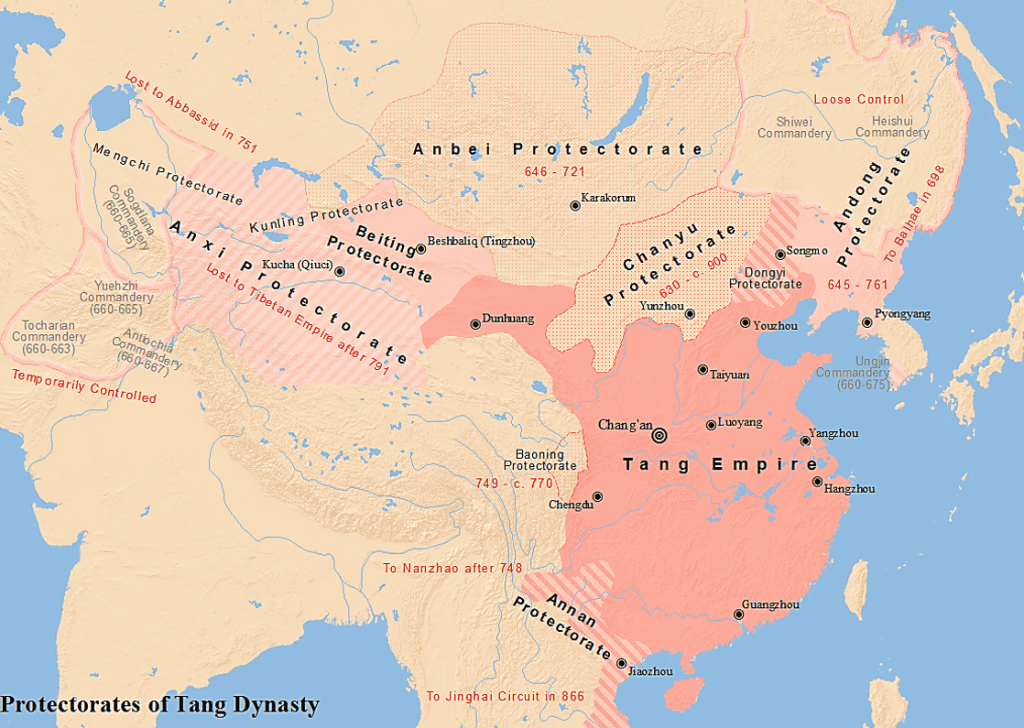
Map of the Tang Empire at the height of its power in the early 8th century
Statues at the tomb of the Gaozong emperor of the Tang

Before meeting his end, Peroz had put up a fight against the invading forces of the nascent Islamic caliphate and keep at least an illusion of ruling his father’s territories. Specifically, following Yazdgerd’s death in 651 in Marw (Merv), Peroz had set up a minor kingdom in a city that the Chinese call Jiling 疾陵, which is usually thought to be the city of Zrang/Zaranj in Sistan.[2] Considering that Sistan was not really invaded until the caliphate of Mu’awiyya (661-663), we can imagine that it was the conquest of Sistan that drove Peroz out of Sistan and to Tukharistan around 663. This would also support Daryaee’s suggestion that all of those Yazdgerd year 20 coin issues were in fact minted in Sistan, presumably in the 10 years of so when he ruled after his father there.[3]

The Conquests of early Islam

On the other hand, Peroz’s appearance in Chang’an happens between 673 and 674[4], meaning that he had spent the previous decade or more in the west. Based on Chinese sources (which might very well be exaggerations), he ruled in Tukharistan, under Chinese auspices, trying to recover his kingdom. Presumably, it is after his arrival in Chang’an that his son, Narseh 涅涅师, was raised to the throne in his stead by the Chinese general in Tukharistan. But Narseh too, after a 20 year struggle, could not recover any territories and returned to China in 708-709 and died in Chang’an. Now, apart from the year 20 issues of Yazdgerd III that we can assume were continually re-issued by Peroz, we have very little evidence of coins from either Peroz or Narseh, while we can only assume that some should have existed as coinage was firmly established in this region both as a sign of authority and for means of circulation. However, no certain coins can be attributed to either authorities, leaving us puzzled.

If we don’t consider the claims of Tang chroniclers as pure fabrication, we should then look at the selection of coins that we do have and consider that they might in fact contain some coins that can be attributed to either Peroz or Narseh, or both. Somehow, these coins have escaped the attention of the scholars somehow, mainly in any clear indication of the name of either authority. The issue is that the inscriptions on the coins of East Iran are written in a maddening variety of scripts, ranging from cursive Bactrian to Pahlavi, Brahmi, and Arabic. A few coins have clearly legible inscriptions, and given the frustrating ambiguities of both the Pahlavi and the Bactrian scripts, all sorts of readings can be proposed. To make things even more complicated, the coins in the region were often issued based on established prototypes, thus coins of the previous authorities – many of them originally based in Sasanian issues of the fourth and fifth centuries. So, it is not too much of a surprise if a coin does not immediately jump out or can be attributed to an authority otherwise known from the pages of standard historical narratives.[5]

The available array of coins from the Hindukush region in the post-Sasanian period is quite bewildering, with many local authorities issuing silver and copper/bronze coins. Many of these coins, for example those of the iltäbär, or Zhulad Gozgan belong to authorities whom we know from historical sources. Others, such as Tegin Khurasan Shah and his son Phrom Kesar, are mainly known from their coins but are entering the gaze of history through discovery of newer sources such as inscriptions.[6] Others such as “Spur Martan Shah,” or “Sero” or “the Bactrian Yabghu” are completely unknown and still waiting identification. So, I would like to venture into a group of these, namely the last named Yabghu, to find some coins that might be connected to Peroz and his son Narseh, the last claimants to the Sasanian throne in the East.

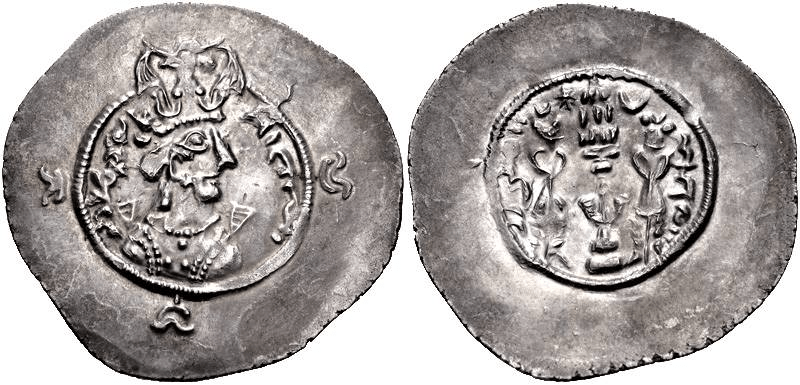
Silver drachm of Zhu(n)lad Gozgan, “Garigo Shaho”

The Yabghu of Balkh/Bactrians

The ultimate source, in English, for the coins that I like to consider here is the monumental two volumes produced by the Austrian numismatist, Klaus Vondrovec, who I can also call a friend and a mentor.[7] In these volumes, Klaus has done a magnificent job of studying the coins from east Iran from the end of the Kushano-Sasanian period to the complete control of the area by the Muslims in the eighth century. His meticulousness has rendered a wonderful resource, detailing typologies, iconographies, and inscriptions of each coin, and providing his own innovative groupings and analysis, mainly based on the previous work by Robert Göbl, but furthering the study of these coins manifold.

Section 9 of Klaus’ work is devoted to the coins produced under the suzerainty of the Western Turk (Gök Türk) Empire, originally founded on the second half of the sixth century and continuing until the late 7th/early 8th century when it was destroyed and temporarily merged into the Tang Empire of China. It was in fact the Chinese advances westwards to destroy the Western Turk that brought them into contact with the Islamic caliphate, resulting in the cataclysmic Battle of Talas that checked both the western ambitions of the Chinese and the eastern expansion of the Caliphate.[8]

The late Sasanian and the Western Turk empires

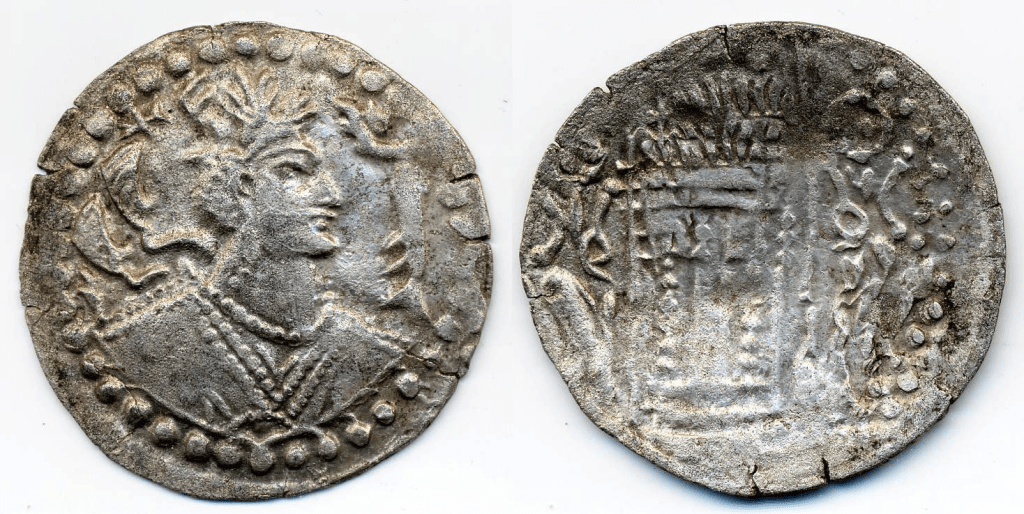
The early coins of this period are the continuation of what Klaus, following a suggestion by Göbl, has called the “Alkhan-Nezak Crossover” series. These are the coins of the period before the Western Turk take over of the Hindu-Kush region and show elements of both the Nezak Shah group (rulers of Kabulistan and Zabulistan), as well as those of the Alkhan group (a group of “Iranian Huns” who had gone over to conquer northern India in the fifth and sixth centuries).[9] By Klaus’ estimation, a part of the Alkhans had returned to the region of Kabul and Zabul and somehow integrated into the Nezak Shahs, and merging their distinctive coinage style with that of the Nezak Shahs, establishing their own Alkhan-Nezak Crossover group.

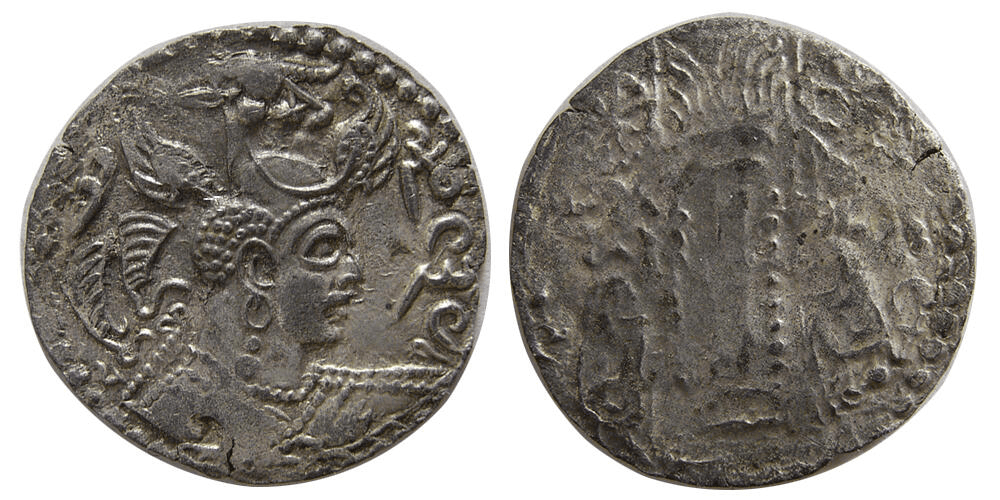
Silber drahm of an Alkhan king
A coin of Nezak Shah
An Alkhan-Nezak Crossover coin

The first authority that Klaus Vondrovec assigns to the Western Turk period is an authority on whose coins inscriptions in Bactria and Brahmi render his name as Sri Shahi (a mix of Indian and Iranian titles: “the Perfect/respected King”). This is respectively written as σριο þαυιο (with spurious Bactrian final -o) in Bactrian and as śrī ṣāhi in Brahmi on two different sets of coins which share the same iconography and typology. On the Nezak and Alkhan-Nezak Cross over coins, the name of the authority, Nezak Shah, was written in the Pahlavi script as nycky’ MLK’.[10] But in these coins, the Sri Shahi inscription has replaced the Pahlavi legend. The dual languages, one showing influences from the northern slopes of the Hindukush, historical Bactria and Tukharistan, and the other from the southern side, Kabul and Gandhara, is interesting and might suggest that Sri Shahi, whoever that he was, had influence over a wide range of area on both sides of the Hindukush, possibly making him a sub-king of the Western Turk, or an independent ruler – if the second half of the seventh century date that Vondrovec gives him is correct.

Coin of Sri Shahi

Another type of coin that Vondrovec mentions bears a Pahlavi legend on it that reads ybgw bhlk’n, so the Yabghu of Bactrians/Balkh.[11] This title would indicate the authority of the issuer in Balkh and Tukharistan, to the north of the Hindukush. However, Klaus reads a reverse legend on the coins as z’wlst(’n) and speculates that these coins might gave been issued in the area of Zabulistan, to the south of the Hindukush. There is an analogy that is suggested here in comparison with the coins of another authority called “Pangul” (who I have suggested is the same person as Amir Banji mentioned by Minhaj Seraj) who seems to call himself both a ruler in Balkh, while issuing coins with the mint signature of Rakhvad (al-Rukhaj) in the area of modern Lashkar Gah in Afghanistan. I am not sure if this can be entertained though, and have a really hard time reading the inscription there as z’wlst the way Vondrovec does. But aside from the mint, the iconography of two of the coin types is interesting and worth looking into.

Specifically, these are Klaus’ types 265 and 266, both showing a beardless man (Vondrovec p. 528). Klaus suggests that these might be a reference to the teenage Ardashir III who ruled the Sasanian empire for a bit more than a year in 628-629/630 and whose coins show a beardless man. But I don’t quite understand why Ardashir III coins should be reissued, with a whole new iconography added, after his death and much later, in the area of Balkh, where he never held any authority. The beardless bust showing an immature person though, that I understand and support!

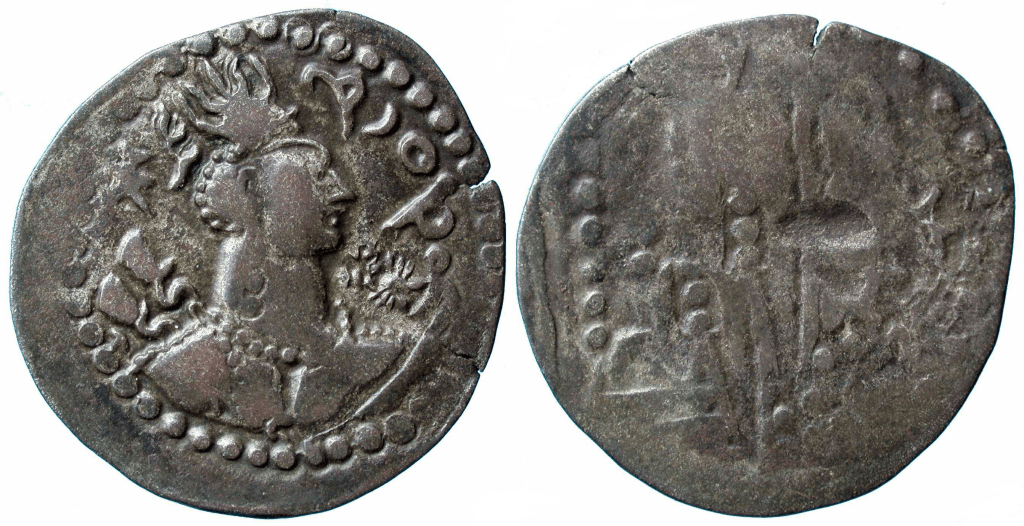
Yabghu of Balkh, type 265, possible authority Narseh (Pahl. nrsyh’)… the mint name reads hlbwc (corrupted for Rakhwad?) year 10?

So, who could this beardless man be? My suggestion here is that this is Narseh, the son of Peroz, who has been left in charge of the Tang Command of Persia after his father’s move to Chang’an. We have no idea of Peroz’ age. Presumably his father, Yazdgerd III, was a teenager himself when he was installed in the throne in 632. We might assume that Peroz was born after this, say 635 to have a round number, and when he died in 678/79, he was about 43-44, a respectable age to die in the 7th century, although quite early. Narseh could have been born quite early and be in his early to mid-twenties, or if we assume a later birth (say while his father was “securely” ruling in Sistan in the 650’s and early 660’s), he would be a teenager indeed. So, the young bust for him would be quite appropriate.

The two types that show the beardless man bear a very elaborate crown. This crown carries the wings on the crown of Yazdgerd III, the father of Peroz, but also has a buffalo’s head on top of an elongated “pedestal”. These buffalo heads were first introduced by the Nēzak Shahs and seem to be their invention, so their appearance on these coins say something about the “local” nature of these issues. While they are very Sasanian in style and bear a Pahlavi legend, they also add a local flavour (and thus authority and circulation) by adding a local piece of iconography. The single border reverse also means that these coins are pre-687 (the shared terminus post quem by which Vondrovec dates the relative date of the later coins) and belong to a period before the introduction of Arab-Sasanian coin types to this region. On some of these issues, I read the legends n(?)rsyh’ in Pahlavi, a name that could clearly point to the identity of the authority as Narseh, the son of Peroz.

A related type, 265A, using the same iconography but showing an older, bearded man, in silver and copper drachms. In addition to being bearded, the bust on the reverse is also wearing a crown with a crescent and a star in the front, something that had become associated with the outside margins on the coins of Khosrow II where they appear in four cardinal points. In front of the bust on some of the coins, a Pahlavi inscription can be read, an I provisionally and with much uncertainty propose the reading of kd(y) bwhl(‘)n for it, possibly to be read as Kay Wahram, although the spelling would be significantly different than the normal spelling of Wahram as wlhl’n, so I have great reservations about it. as One thing that unites all these coins, aside from the iconography, is the presence of “tamga S 61”, a sign consisting of a half circle with another sign, resembling an open V with wings. These tamgas appear in the same places that a crescent and a star would appear on the coins of Khosrow II, on the outside margins of the obverse, except one example of it occurring on the reverse as well of the type 265A, variant 3. Coins of type 265A also carry a mint year of 15, although it is not specified based on which calendar. The coins also mainly carry the mint name of LHW, localising them in Rakhwad/Al-Rukhaj, in Sistan. We can only assume that this is a reference to the regnal year of the authority it depicts. I would attribute this related type as either issued by Narseh himself when he was older, or possibly belonging to Peroz, or his brother Wahram?, issued before he had to leave for China.

Yabghu of Balkh, type 265A, possibly with Pahl. kd(y) bwhl(‘)n (Kay Wahram?) on the reverse, mint LHW(d)? (Rakhwad/al-Rukhkhaj?)

The question remains as why the names of the authorities cannot be found on the coin. In my opinion, there are two answers to be given here. One is that these Yabghus, bearing a title that we known from the Hephthalite period onwards, were actually governors of Peroz and Narseh, ruling over some of the dudufus 都督府 of the Tang Persian (Anxi) Protectorate 安西都護府, and thus issuing coins using their title and the position. Alternatively, these are Peroz and Narseh themselves, but that living under Tang suzerainty, they only mention their position as Yabghus of Balkh, on their coins. However, the extension of their power to the southern Hindukush, observed from the spread of the coinage circulation to Zabulistan – much like Sri Shahi – is an indication of their wider influence beyond Balkh, perhaps even expressing their claim to Sistan, from which Peroz had escaped to Balkh.

The administrative divisions of the Tang Empire in the west

[1] Quite a few studies of these, some with more care than others, have been published. The sources are still most easily available in Chavannes, Edouard. 1903. Documents Sur Le Toukiue (Turcs) Occidentaux. St. Petersburg: Commissionnaires de l’Académie Impériale des Sciences. Daffina’s short, but monumental work remains one of the best studies of the subject, Daffinà, Paolo. 1983. “La Persia Sassanide Secondo Le Fonti Cinesi.” Rivista Degli Studi Orientali 57: 121–70. A brief discussion of all these plus newer observations is Compareti, Matteo. 2003. “The Last Sasanians in China.” Eurasian Studies 2 (2): 197–213.

[2] Comparetti 2003, 206. However, see Hamidreza Pashazanous, Ehsan Afkande, “the Last Sasanians in Eastern Iran and China” Anabasis 5 (2014), 139-153 for an argument against this, rather putting Jiling in Tukharistan.

[3] Daryaee, Touraj. 2006. “Yazdgerd III’s Last Year: Coinage and the History of Sistan at the End of Late Antiquity.” Iranistik: Deutschsprachige Zeitschrift Fur Iranistische Studien 5 (1 & 2): 21–29.

[4] Comparetti 2003, 207

[5] For an example of this, see my article identifying certain coins from the area of western Tukharistan as belonging to characters said to be the ancestors of the Amirs of Ghur by the famous 13th century historian, Minhaj Siraj Jowzjani in his Tabaqat-e Nasseri: K. Rezakhani. 2020. “Pangul and Bunji, Zhulad and Fulad: a Note on the Genealogy of the Shanasbid Amirs of Ghur.” In Dinars and Dirhams: Festschrift in Honor of Michael L. Bates, edited by Touraj Daryaee, Judith A. Lerner, and Virginie Rey, 219–30. Irvine: Jordan Center for Persian Studies and Culture.

[6] For the newest example of this, see Nicholas Sims-Williams. 2020. “The Bactrian Inscription of Jaghori: A Preliminary Reading.” Bulletin of the Asia Institute 30.

[7] Klaus Vondrovec. 2014. Coinage of the Iranian Huns and Their Successors from Bactria to Gandhara (4th to 8th Century CE). Vienna: Verlag der Österreichischen Akademie der Wissenschaften.

[8] For a general review, see Denis Sinor. 1990. “The Establishment and Dissolution of the Türk Empire.” In The Cambridge History of Early Inner Asia, edited by Denis Sinor, I:285–316. Cambridge: Cambridge University Press.

[9] For these, see the excellent work produced by another brilliant Austrian scholar, Matthias Pfisterer, 2013. Hunnen in Indien. Vienna: Verlag der Österreichischen Akademie der Wissenschaften.

[10] The reading of this inscription, previously read as Napki Malka and long known as that, is one of the more exciting stories of ancient studies. See J. Harmatta. 1969. Late Bactrian Inscriptions, Acta Antiqua Academiae Scientiarum Hungaricae 17, 408, and Richard N. Frye, “Napki Malka and the Kushano-Sasanians,” in Near Eastern Numismatics, Iconography, Epigraphy and History: Studies in Honor of George C. Miles, ed. Dikran K. Kouymjian (Beirut, 1974), 115–22.

[11] There is some debate as how to read this, either as Bactrians or Balkh (see Vondrovec p. 527 and other places). I prefer to consider this “that of Balkh” (in analogy to Ērān) and don’t get too worried if this is a reference to the people or the land.

Bibliographia Iranica

The new episodes of the podcast are on their way. In the meantime, I invite the readers to check out the blog of my friend and colleague Arash Zeini, now a collective effort of him and several other friends, which is dedicated to introducing the new publications in Iranian Studies. The blog is a great resource and I will use it from here on as a resource for the podcast and for the History Page. Check it out here!

Elamite names “galore”

One of the dear readers of this weblog, and listeners to the podcast, suggested that I make a list of the names I so much enjoy pronouncing. I think it is a good idea, except someone has already done it: http://en.wikipedia.org/wiki/List_of_rulers_of_Elam (for the chaps mentioned this week, scroll down to the Neo-Elamite period).

You should notice that pronunciation occasionally vary. Some of the Elamite pronunciations are being perfected. Temti-Human-Inshushinak now seems to be more like Tepti-Humban-Inshushinak (which is the way I say it). Some are better known (if you can say that about anything Elamite) by their Akkadian names. Shutruk-Nahunte is sometimes written Shutruk-nakhunte or Shutruk-Nahhunte. These are attempts at rendering Elamite in English. The sound /h/ in his name is a laryngeal sound which does not exist in English, similar to Arabic ح. 

Apart from these Elamites, I mentioned a few Assyrians and some Babylonians. Sargon II, Esarhaddon, Sennacherib, and Ashurbanipal are the Assyrian ones. Merodach-Baladan the Chaldean was really the only “Babylonian” I mentioned. 

I will post a similar list from the next episode on. 

Episode 8: the Neo-Elamite Kingdom

Well, here it is FINALLY! I got things to work, and meanwhile everything has changed (the feed is still the same)

This episode goes back to the Elamites and their adventures with the Neo-Assyrians, and their murky last century.

Here are a couple of more readings, one on the chronology of the Neo-Elamite period based on newer finds, and the second on Neo-Elamite “acculturation.”

A book on the Arjan Tomb, an important late Elamite discovery (you can read a condensed version with detailed interpretations here)

A map of Mesopotamia in the first century BCE

A map of Mesopotamia in the first century BCE

Seal of Humban-Kitin, son of Shutruk-Nahhunte II

Seal of Humban-Kitin, son of Shutruk-Nahhunte II

Eshkaft-e Salman in Izeh/Malamir

Eshkaft-e Salman in Izeh/Malamir

Hani, the "eastern" Elamite ruler, along with his wife and child, Eshkaft-e Salman, Izeh

Hani, the “eastern” Elamite ruler, along with his wife and child, Eshkaft-e Salman, Izeh

Neo-Elamite beaker, probably from Susa

Neo-Elamite beaker, probably from Susa

Assyrian victory relief of Ashirbanipal, showing Elamites being deported

Assyrian victory relief of Ashirbanipal, showing Elamites being deported

the bowl from the Arjan Tomb

the bowl from the Arjan Tomb


Episode 7: Indo-Europeans and Indo-Iranians

Here is the link to the episode, and the feed

This, sort of, is just the beginning. The Indo-European, the Aryan, and the Indo-Iranian languages and terms are such thorny issues, and I cannot even pretend to have answered them all. Hopefully this will set the stage for future discussions, and some questions, comments, and discussions here.

Notice that I tend to spell the word Ariia in order to name the “Indo-Iranians” as they are, and to distinguish it from the Aryan, which is used in a modern, political sense.

Check out the Bibliography for some book and article suggestions…

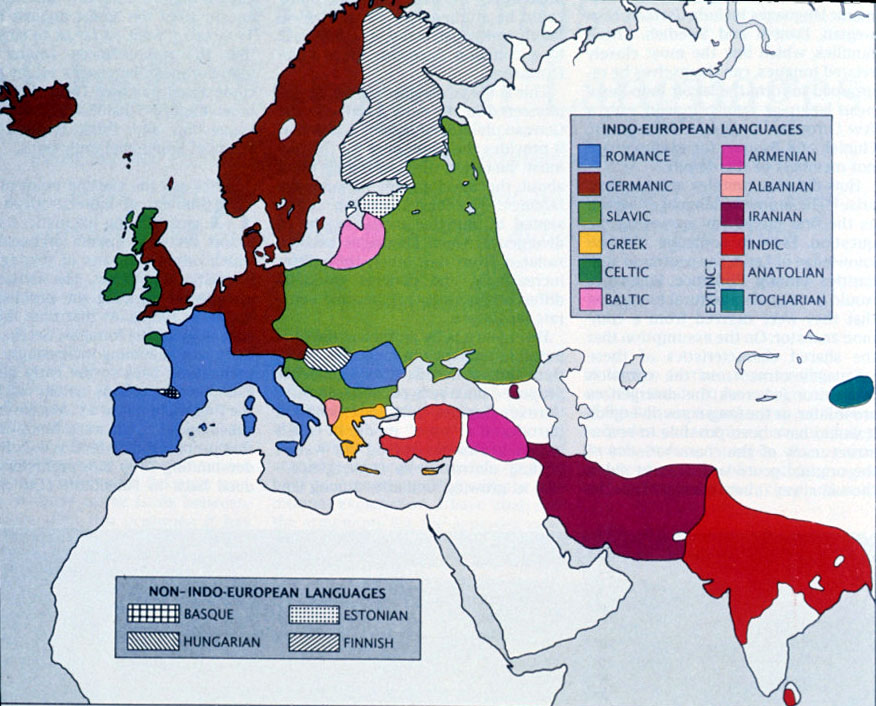
Schematic map of major Indo-European language groups

Schematic map of major Indo-European language groups

Map showing the extent of the Andronovo and BMAC cultures

Map showing the extent of the Andronovo and BMAC cultures

Episode 5: the Middle Elamite Kingdoms

The new episode is out. As usual, you can get it directly from here or subscribe to it from FeedBurner

I owe everyone an apology. I have moved for the year from Europe to North America, and the move proved more overwhelming that I imagined. I had to arrange too many things, teach, and do much writing. I have everything under control now, and will be sticking to a real schedule henceforth.

As for the episode, it is full of weird names, so here is something to orient you (and here is a useful list of all Elamite rulers, real and fictional!):

Names:

Kidinu: founder of the first dynasty (Middle Elamite I: Kidinuids)

Tepti-Ahar: the Kidinuid king who founded the site of Haft Tepe (Kabnak) near Susa, where his tomb also is.

Igi-halki: the founder of the second dynasty (Middle Elamite II: the Igihalkids)

Untash-Napirisha: the most important king of the Igihalkids, a maternal grandson of Kurigalzu I of Babylonia (of the Kassite dynasty).

Kidin-Hutran III: the Igilhakid who removed Assyrian puppets from the Babylonian throne.

Tukulti-Nimurta: the Assyrian king who removed the legitimate line of Kassite kings; they were later restored

Shutruk-Nahhunte: the founder and greatest ruler of the Middle Elamite III dynasty, the Shutrukids. He conquered Babylonia and put and end to the rule of the Kassites.

Kutir-Nahhunte: son and successor of Shutruk-Nahhunte

Shilhak-Inshushinak: brother and successor of Kutir-Nahhunte and the last great king of the Shutrukids

Sites:

Susa: Shusha; the low-land capital of Elam

Anshan/Anzan: the highland capital of Elam

Haft Tepe/Kabnak: site east of Susa; tomb of Tepti-Ahar

Al-Untash-Napirisaha: the archaeological site of Chogha Zanbil, with its impressive Ziggurat; the religious and political centre of the Igilhakids, near Deh-e Now, their home town.

Nebuchadnezzar I: the fourth king of the Babylonian dynasty of the Sealand and the bane of the Shutrukids

Hutelutush-Inshushinak: the last of the Shutrukids; he escaped Nebuchadnezzar and took refuge in Anshan/Anzan; also reliefs at Kul-e Farah in Izeh.

Middle Elamite relief from Kul-e Farah (Izeh)

Middle Elamite relief from Kul-e Farah (Izeh)

The Ziggurat of Chogha Zanbil

The Ziggurat of Chogha Zanbil

The aerial view of Chogha Zanbil/Al-Untash-Napirisha

The aerial view of Chogha Zanbil/Al-Untash-Napirisha

Episode 3: From Pre-History to History

— This is episode three, out after some mishaps… Download/Stream it from here

— As usual, subscribe via Feedburner here, and you can always look for it on the iTunes and other podcast directories (Podbay?).

— I promised a list of terms and names I was using, so here they are.

Chalcolithic = the so-called “copper” age, or the coper-stone period

Elam = The civilisation I talked about the most, and will continue talking about for the next episode

Tepe Sialk = Archaeological site in central-northern part of the plateau

Tepe Hissar= Archaeological site on the northeast of the Iranian Plateau

Shahr-e Sukhte = the Burnt City, site on the east side of the plateau, by the Helmand River

Sargon of Agade = the first king of the Empire of Agade/Akkad (2332 BCE).

Gutians and Lulubians = mountain tribes/confederations to the north of Elam

Jiroft = archaeological side on the central eastern part of the plateau

Naram-Sin= Grandson of Sargon

Ur-Namma (2112-2095) = the founder of the Third Dynasty of Ur

Puzur Inshushinak = contemporary of Ur-Namma, king of Awan, the first Elamite ever mentioned

Shimashki= the dominant city of Elam after 2004 BC

Sukkalmah=the title of the “governor” of Elam under Larsa’s dominance; later the most powerful rulers in the region

Gungunum of Larsa (1932-1906) = the founder of the dynasty of Larsa

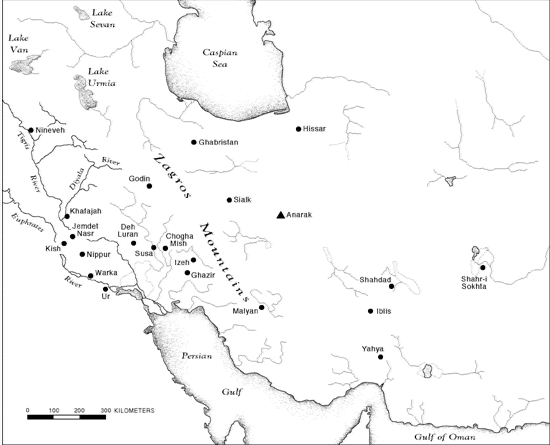
And here is a map (note that Malyan is Anshan!)

mesoiranmap

Episode 2: Geography

Episode 2 is released… download or stream it from here

Of course, you can subscribe from here too!

Here is the map for the episode

Topographic Map

Topographic Map of Central and West Asia